Where does your course knowledge live?
Golf courses are constantly evolving.
Projects move from planning to delivery. Irrigation, drainage and infrastructure are upgraded. Playing areas and course presentation are refined. Vegetation, waterways and habitat areas are managed over time.
Every decision adds to the history of the course. But where is that history retained?
At many clubs, important course knowledge lives in the minds of a small number of people. The superintendent remembers why an area is managed differently. An assistant knows what struggled during the last planting program. A committee member recalls why a project was approved, while a contractor holds the original plans and photographs.
Other information is spread across spreadsheets, emails, reports, shared drives, WhatsApp conversations and personal phones.
This can work while the same people remain available and remember the detail. The problem emerges when someone leaves, changes roles, takes extended leave—or is asked about a decision made several years ago.
If your superintendent or assistant was unavailable tomorrow, could someone else find the history, decisions and follow-up behind an important course project?
When course knowledge is scattered
The consequences are not always immediately obvious. They appear gradually through repeated questions, duplicated work and time spent searching.
A new staff member cannot find the history of a project. A committee asks what was achieved for the money invested. A consultant repeats an assessment because the previous report cannot be located. A project experiences the same establishment problems as the one before it because the lessons were never retained.
The club may know valuable work has occurred but struggle to demonstrate:
What was completed
Where it happened
Why a particular approach was chosen
What resources were invested
Whether follow-up occurred
What changed over time
This creates key-person dependency. The course belongs to the club, but much of its operational history effectively belongs to the people who remember it.
That is a risk for the club and an ongoing burden for those individuals.
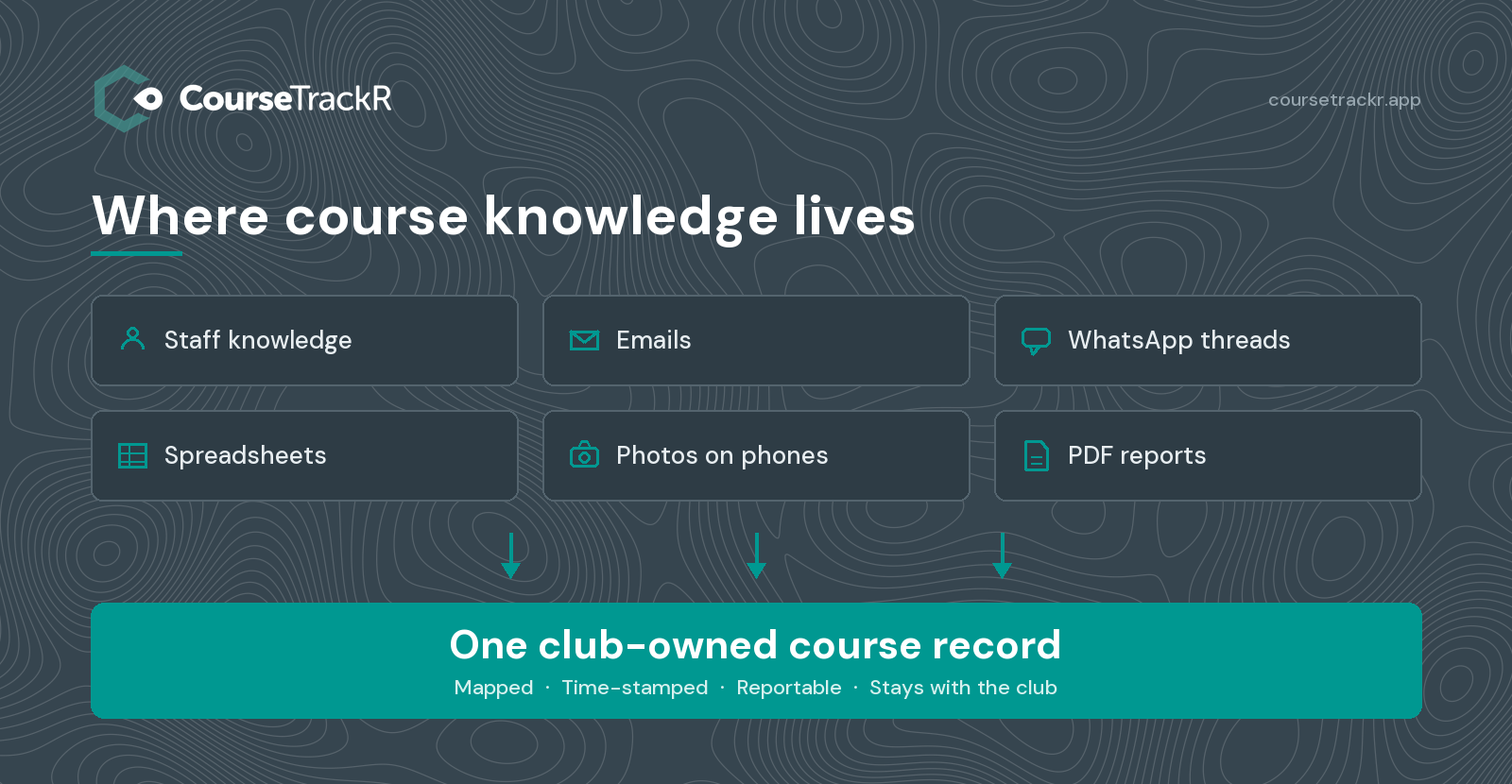
Information needs context
Most clubs already hold a considerable amount of course information. The issue is that it is often disconnected.
A spreadsheet may show that 1,000 plants were purchased. Photographs capture the planting day. An invoice records the cost, while a committee report explains why the project was approved.
But can someone easily see exactly where the plants went, which species were used, how the site was prepared, what maintenance followed and what should happen next?
Useful course knowledge should explain:
What happened
Where it happened
When it occurred
Why the decision was made
What evidence supports it
What follow-up is required
Without that context, clubs are storing files rather than building a lasting course record.
Keep the information together
Most clubs already have plenty of course information. The problem is that it often sits in different places.
A spreadsheet might record what was purchased. Photographs sit on someone’s phone. An invoice shows the cost. A committee presentation explains why the project was approved, while follow-up actions are discussed in emails or messages.
Individually, each item is useful. But finding and bringing everything together again can take time.
A useful course record should make it easy to understand:
What happened
Where it happened
When it happened
Why the work was needed
What photographs or documents relate to it
What still needs to happen
Connecting the record to the course map also makes the location clear. Staff do not need specialist mapping knowledge. They simply identify where the work occurred and add the relevant information.
This means someone looking at the area later can understand its history without having to search through folders, old emails or several different systems.
Record it once and use it again
Course teams are time-poor. Keeping better records should not mean creating more work.
The aim is to capture useful information as the work happens, then use that same information again when it is needed.
A work record containing the location, date, notes and photographs can help the team manage follow-up. It can also be used later for:
A committee or board report
A budget discussion
A staff handover
A consultant briefing
A member update
A story about improvements happening across the course
Instead of searching for photographs, checking old spreadsheets and rebuilding another PowerPoint presentation, the information is already together and ready to use.
This is the real benefit of recording something once: it can support day-to-day course management as well as reporting and storytelling later.
Start with what you are doing now
Clubs do not need to go back and recreate the entire history of the course.
Start with one current project or an area receiving regular work. Record where it is, what the club is trying to achieve, what work is happening and what needs to happen next.
As more activity is added, the club gradually builds a clearer and more useful record of the course.
CourseTrackR brings projects, course works, follow-up actions, photographs, documents, team communication, biodiversity records and reporting together around the actual course map.
The team can record work as it happens and then use the same information for follow-up, reports and club updates—without starting from scratch each time.
The work may already be happening and the knowledge may already exist.
The important question is whether the club can easily find it, use it and keep it for the future.
Where does your course knowledge live today—and would it still be there if the people changed tomorrow?